I do quite a bit of RC flying, including most of the basic aerobatic manoeuvres. But I have yet to get comfortable with the more difficult ones, especially many of those used in 3D flying. I’m now on a campaign to improve that situation, so I’m beginning with understanding all I can about what is going on. This article walks you through the technical side of that journey, and conclusions that I have come to. Following this I will put it all to the test up in the air, and we will see whether Mr. Newton and RC Jim really have their head on straight.
Us engineers love free body diagrams. You draw a picture of the item, then draw lines showing the positions and directions of forces and torques acting upon that body. If it is not accelerating in any direction, then all of the forces in a given direction will cancel out to nothing, as well as any moments (twisting forces) around any given point. So, that would be true of a plane flying straight at a constant speed:
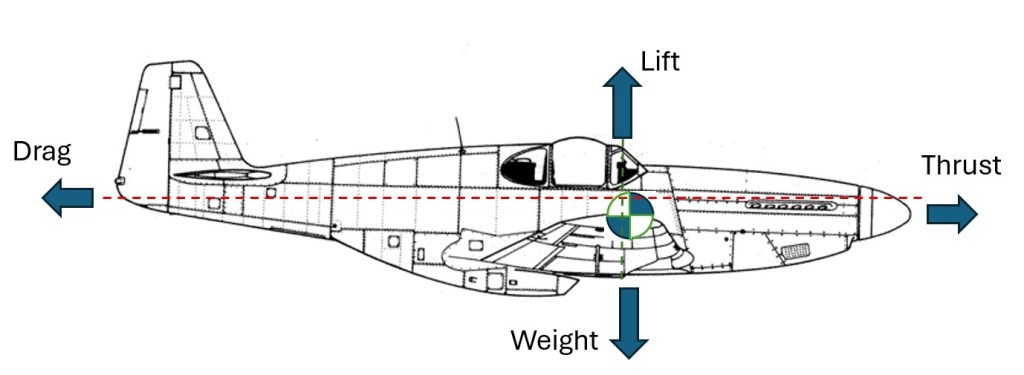
In this example, lift equals weight and thrust equals drag. They cancel each other out, so the plane isn’t speeding up or slowing down, and in this position, it’s not gaining or losing altitude. The centre of lift is slightly behind the CG, and the centre of thrust is slightly lower than the centre of drag. The weight is greater than the thrust, so to make the ‘twisting’ moments equal, the distance between the lift and weight is shorter than that between the thrust and drag.
Got the idea?
Now, let’s look at what might be needed to balance the trims on a plane in a knife edge, so that it continues straight without twisting. First of all, let’s look at it from the top. As we do so, we will assume that forces in the vertical will all cancel out, so we are just looking at forces fore and aft as well as side to side.
Note that for any forces that are not perfectly horizontal or vertical, we will divide them into those two components. So, the force below can be divided into two parts:

The blue arrow on the left is equal to the combination of the two blue arrow forces on the right. The point upon which they are acting is the opposite end from where the arrow head is located.
View from above, with plane on knife edge:
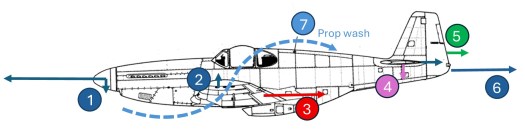
Observations
- Downthrust from motor, if any. The downthrust will be balanced by a smaller force from ‘up’ elevator. Depending on the CG location, this may have also been needed for normal flight, so it may not have an effect on knife edge flight. If it does, it could help to counteract a tendency to turn toward the canopy on knife edge. That might be minimal, but if you are flying a 3D plane in a harrier mode (slow, nose up, lots of power), then it should be a consideration.
- With the plane flying straight in this view, some lift will still be generated by the wing. If the centre of gravity is located right on the centre of lift, this should have minimal effect on the knife edge elevator mix. Other things being equal, the plane should continue to fly straight, however it would be moving towards the cockpit side. Not ‘pitching’ but ‘translating’ – the plane would be moving in that direction without rotating. Note that the elevator mix will have a pronounced effect on what level, if any, of lift is generated. It could reduce the angle of attack to zero and have no lift generated.
- With minimal lift generated by the main wing, drag from the wing will be reduced. For a low wing plane this should make it turn towards the cockpit. This is a good reason for an aerobatic plane to either have a wing attached in the centre of the fuselage, or be a biplane with one wing on the top, and one wing on the bottom.
- The plane can be setup with trim to the elevator either up or down in level flight. We are trying to work out how this should be altered with a mix for stable knife edge flight.
- On the knife edge there will be a lot of rudder deflection to push the tail down and the nose up. This will increase drag generated by the rudder.
- The fuselage will be pushing sideways through the air, creating extra drag.
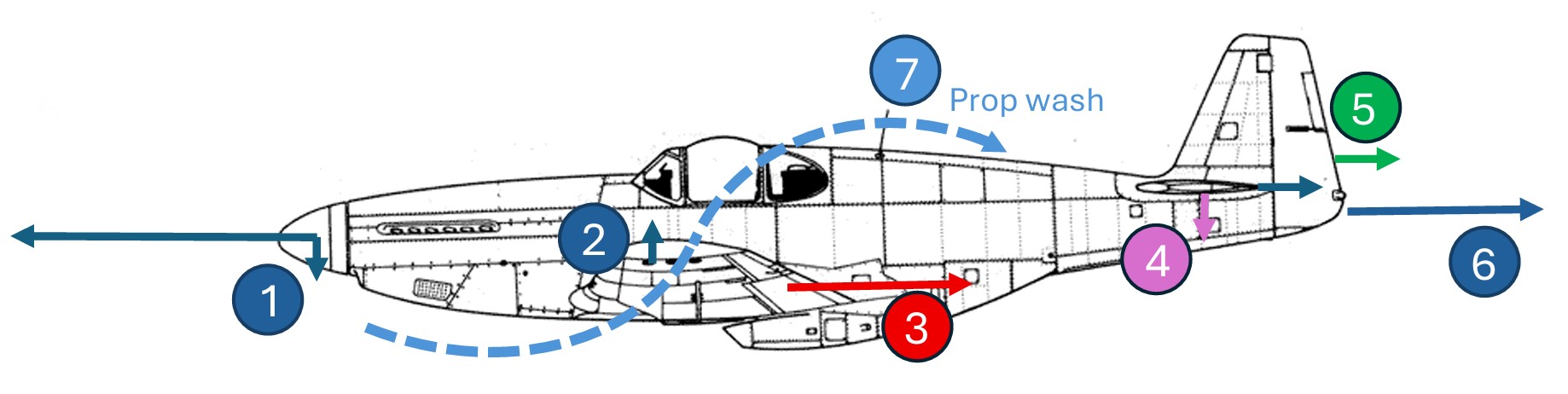
- The prop wash has no effect on pitch or overall lift. What happens on one side of the plane on the wings and horizontal stabilizer is counteracted by what’s happening on the other side. The force from propwash on the vertical fin produces yaw, which is not what we are looking at in this view.
Conclusion
For a low wing plane, it is likely that it will want to pull towards the canopy in knife edge flight. This is because the two main contributors, reduced drag from the main wing, and increased drag from the rudder, are both pulling in that direction. So, a down elevator mix with input from the rudder in either direction is likely to be needed.
Front view
Here we have a plane coming at us on a knife edge; however, note that it would actually be travelling somewhat nose up.
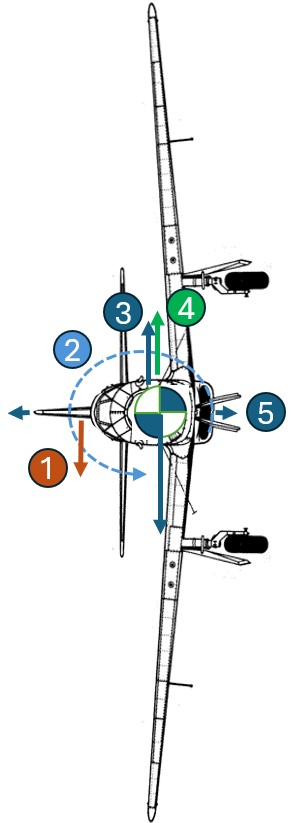
Observations
- With the elevator holding the nose up, it is pushing down on the back of the plane. Note that the direction of the arrow is the direction of the force, not the position of the elevator.
- Propwash is trying to rotate the plane counter clockwise as it strikes the flying surfaces; however, an opposite torque is taking place on the plane as the engine tries to keep spinning the prop.
We do note that the propwash hitting the vertical fin tends to push the tail to the pilot’s right, and therefore the nose to the left. Generally, we see this effect very pronounced with some planes on take-off, but less so when up to speed. However, this may mean that less rudder is needed when having the right wing down in knife edge as compared to needing more rudder when flying with the left wing down. While either way the plane is kept in the needed position to maintain the desired attitude, it is doing it with different rudder inputs, which would change the amount of mix being provided to the ailerons. So, there might need to be a greater amount of mix being added to the left wing down side of the mix. - With the nose tilted upwards there is a significant upward component of the thrust.
- The fuselage and winglets, if any, are generating some amount of upwards lift.
- Downthrust from motor and lift from wing. These will have no effect on roll, and have been dealt with in the other view.
Conclusion
This is a difficult one, but as items 3 and 4 are very close to the CG. But since the propwash is counteracted by the torque being applied to the prop, my thinking is that the force on the rudder is going to be what needs to be counteracted with the aileron trim. With the plane going in this direction, it would tend to roll toward the canopy. That would mean that left aileron would need to be added. Going in the opposite direction, additional right aileron would be required.
With a flatter fuselage, such as with a pattern plane or a profile plane, significant lift will be generated by the fuselage, and less down force from the elevator, so depending on motor position, the result could be different. Winglets would also have this effect. A small vertical fin with winglet over the canopy will tend to counteract any roll toward the canopy.
Thoughts on coupling
A lot has been said about what is and what isn’t coupling. Generally, it seems that the tendency of the plane to either pitch or roll to the side during a knife edge is referred to as coupling. That brings questions to my engineer brain (what’s left of it, at least!)
What makes sense about it is that the forces applied to the plane when flying knife edge are generally something to make it hold its attitude and altitude, but uncorrected they also cause it to turn or roll.
On the other hand, what is counter-intuitive for me is that what is happening is just a sensible thing related to the forces involved, as discussed above. It’s not like trying to turn a gyroscope in one direction and having it move 90 degrees to that direction.
However, I will concede that it is a useful description. In knife edge flight, the rudder is in the position that will make the plane lift or drop the nose, but when we apply rudder to lift the nose, it does lift the nose, but it also turns away or rolls away. That’s coupling.

